VRAM, Bandwidth, and Architecture: Reading Past the Marketing Numbers
Graphics card marketing leans hard on a handful of headline numbers. Here is how to read those numbers in context instead of taking them at face value.
Main page for graphics cards: Graphics Cards →
Graphics card marketing leans hard on a handful of headline numbers. Here is how to read those numbers in context instead of taking them at face value.
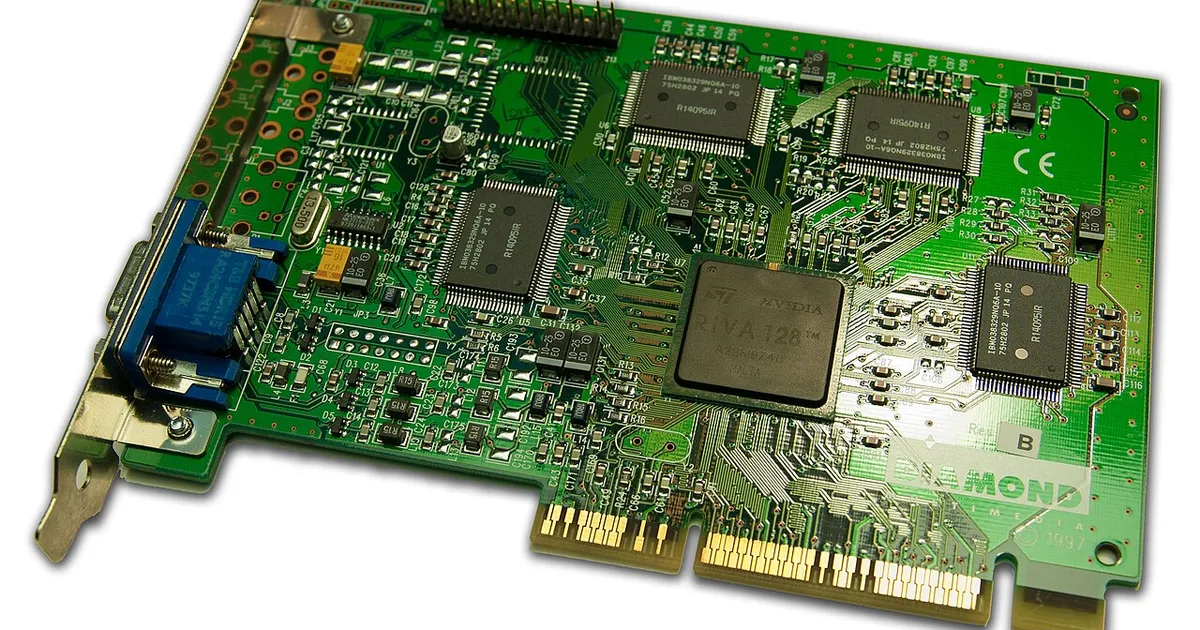
Photo by Timothy Borkowski / Wikimedia Commons / CC BY-SA 3.0
Graphics card marketing tends to lead with a small set of numbers — memory capacity, clock speed, a generation name — because they’re easy to put on a box and easy to compare at a glance. The problem is that easy-to-compare and actually meaningful aren’t the same thing. Learning to read these numbers in context, rather than at face value, changes how you interpret a spec sheet entirely.
VRAM capacity is a headline number that invites the wrong comparison
Memory capacity is probably the single most marketed graphics card spec, largely because it’s an easy, big-looking number. But as a standalone figure, it doesn’t tell you how a card performs — it tells you how much data it can hold before running into trouble. A card with more capacity than it can effectively use with its actual rendering performance isn’t gaining anything from that extra capacity in practice. Treating capacity as the primary comparison point, rather than one input among several, is one of the most common ways people misjudge a graphics card comparison.
Bandwidth describes a different bottleneck than capacity
Where capacity is about how much data a card can store, bandwidth is about how quickly it can move that data. A card can have generous capacity and still be limited by how fast it can actually read and write to that memory during demanding scenes. Bandwidth numbers are less prominently marketed than capacity, partly because they’re less immediately intuitive, but they often explain performance differences between cards that look similar on a capacity-only comparison.
Architecture generation changes what a given number means
The same raw specification — a given amount of memory, a given clock speed — can produce meaningfully different real-world performance depending on the underlying architecture generation. Manufacturers regularly improve how efficiently a given architecture uses its resources, which means a newer generation can outperform an older one with superficially similar specs. This is the trap in comparing specs across generations: two cards can share a number on paper while belonging to genuinely different performance tiers because of what’s changed underneath.
Clock speed is often the most overweighted number of all
Clock speed gets attention because it’s simple and familiar, but it’s one of the least reliable numbers to compare across different architectures or product lines. A higher clock speed on an older or less efficient architecture doesn’t necessarily beat a lower clock speed on a newer, more efficient one. Clock speed is genuinely useful for comparing very similar cards within the same generation and product line, but it loses most of its comparative value the moment you’re comparing across different architectures.
Software and driver support shape the real-world outcome too
Two cards with comparable hardware specifications can still deliver different practical experiences depending on how well their drivers and software support are maintained, and how well specific games are optimized for that hardware. This is a harder factor to quantify than a spec sheet number, but it’s a real part of the comparison — hardware specifications describe potential, not a guaranteed outcome in every game.
The habit worth building
When comparing graphics cards, it helps to treat every individual number as incomplete on its own — capacity without bandwidth context, clock speed without architecture context, any spec without power draw and physical fit context. None of these numbers are meaningless, but none of them tell the full story alone either. Reading them together, rather than picking a favorite headline figure, is what separates an informed comparison from a marketing-driven one.
Our picks: Graphics cards
Shop on Amazon
Affiliate links.As an Amazon Associate I earn from qualifying purchases. Links below go to Amazon; prices and availability change, so check Amazon for current pricing.Affiliate disclosure
NVIDIA GeForce RTX 5070 Ti
16GB card that handles high-refresh 1440p and entry 4K.
Check price on AmazonNVIDIA GeForce RTX 5060 Ti 16GB
Budget-friendly 1080p/1440p pick; get the 16GB version.
Check price on Amazon
Illustrative photos: Photo by Timothy Borkowski / Wikimedia Commons / CC BY-SA 3.0; Photo by Advanced Micro Devices, Inc. (AMD) / Wikimedia Commons / Attribution